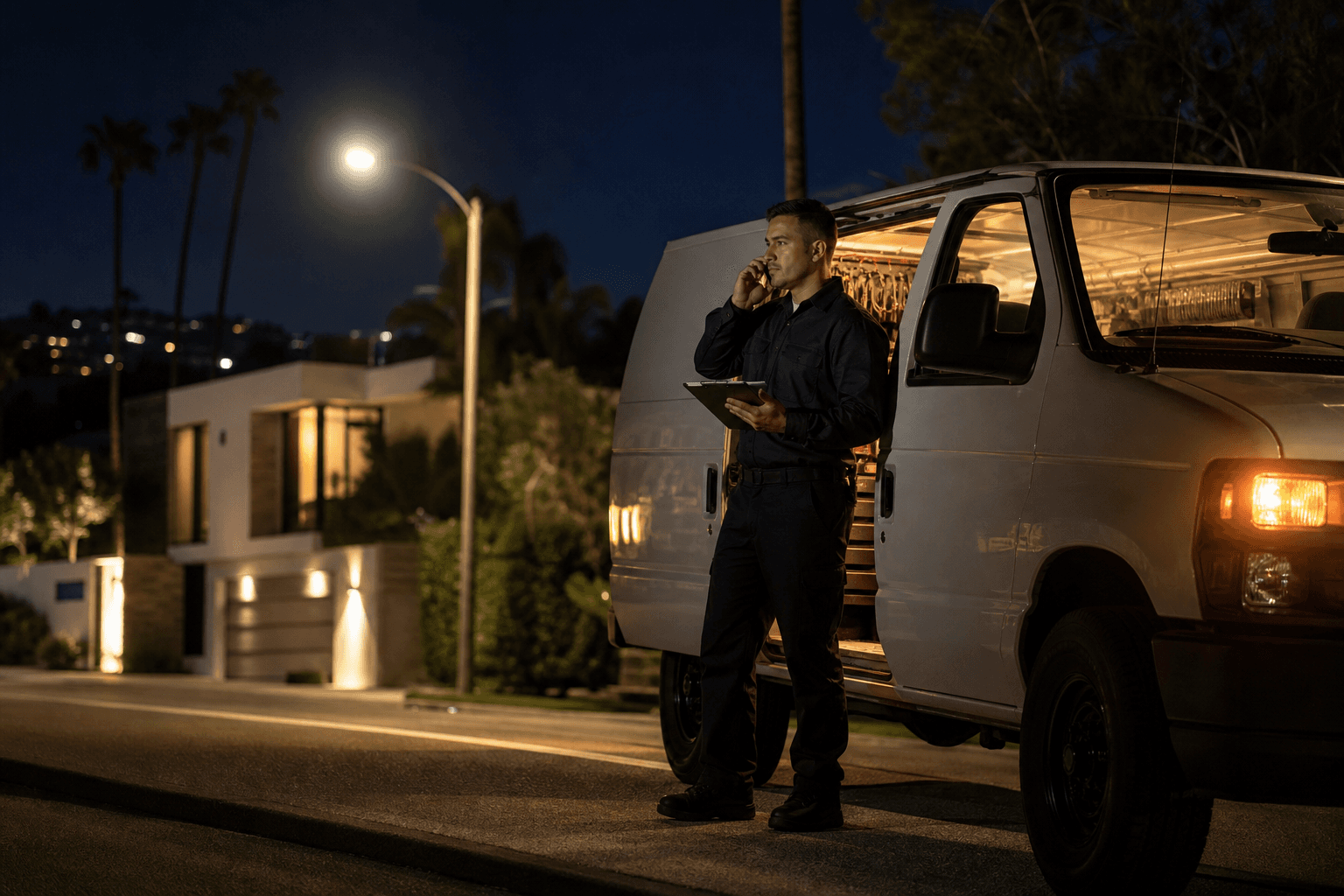
Why the scam playbook works
Locksmith scams thrive on three things: customers being in a hurry (you're locked out, it's late, you just want help), customers not knowing the real price range, and customers being unwilling to push back on a technician already standing at their door. The scammers know all three. The playbook is decades old, runs nationally, and shows up in every metro in America — but it's especially heavy in big markets like LA, San Francisco, and the Bay Area where call volume is high. The good news: once you know the pattern, it's actually easy to spot. Here's the full anatomy of a scam locksmith call, and how to short-circuit it.
Red flag #1: extremely low advertised price
If a Google ad or website says "$19 service call," "$29 lockout — any door, any time," or "starting at $15," it is not a real locksmith company. It's a lead-generation funnel. The dispatch center is usually in another state (Florida, Texas, or overseas), and they sub-contract to whoever is nearest you. The real minimum service-call cost in California in 2026 is $40-$80 for the dispatch + first cylinder. Anyone advertising below that has to make up the difference somewhere — and "somewhere" is on your invoice an hour later.
Red flag #2: generic, evasive phone answer
Real local locksmiths answer the phone with the company name and a real human. Scam dispatchers use generic openers — "locksmith," "locksmith service," "yes, how can I help you" — because the same call center is fronting for dozens of brand names. If you ask "what's the company name?" you'll often get a different answer than the one in the ad. What to do: ask "what is the legal name of the company?" and "where is the dispatcher located?" A real shop answers both immediately. A scam dispatcher gets evasive or hangs up.
Red flag #3: unmarked van, unmarked uniform
When the technician arrives, they should be in a clearly marked van and a uniform with the company name. They should also have ID. A scam technician usually arrives in an unmarked vehicle, in plain clothes, and refuses to show ID. Some will wear a uniform with a vague generic logo ("Locksmith Services") — that's almost as bad as no uniform. What to do: ask for ID and a business card before you authorize any work. A real locksmith hands them over. A scammer either improvises or gets aggressive.
Red flag #4: "drilling required" with no inspection
The single most common scam tactic in LA is opening with "drilling required" before the technician has even looked at the lock carefully. Drilling is the most expensive way to open a lock — it requires a full lock replacement afterward — and it's the easiest way to triple a $89 lockout into a $400+ invoice in 10 minutes. The truth: a real locksmith opens the large majority of standard residential and commercial locks non-destructively, using picks, bypass tools, impressioning, or specialized techniques. Drilling is a last resort for genuinely damaged or unusually high-security locks, not a default tactic on a basic Schlage or Kwikset deadbolt. What to do: refuse to authorize drilling without a written quote that explains why non-destructive entry isn't possible. If the technician won't or can't explain it in plain English, send them away and call a different shop.
Red flag #5: no written quote before work begins
Reputable California locksmiths give you a written, signed quote before any tool comes out of the bag. Not "around $200, give or take" — an actual number on paper or a digital signature pad, with the line items spelled out (service call, labor, hardware, after-hours surcharge if any). If the technician says "let's just get started and we'll figure out the price after" — full stop. That is the scam. The "after" price is whatever they decide it is, and you've already let them work, which makes pushing back much harder. What to do: insist on the quote in writing. If they refuse, tell them you're calling a different locksmith and they should leave. They will leave. They have other people to scam.
The five-second sniff tests that work
Before you ever pick up the phone, run this checklist on the locksmith's online presence:
- Real local phone number? California area codes start with 213, 310, 323, 408, 415, 424, 510, 562, 619, 626, 650, 707, 714, 747, 805, 818, 831, 858, 909, 925, 949, etc. A toll-free 800/888 *can* still be legitimate (we use one), but a real shop also has at least one CA-area-code line.
- Can they say where they are based? A legitimate company can name the city it dispatches from and, if it has a storefront, the address. A mobile-only company should still have a real business name and a verifiable California license number. A scam front gives a fake address or none at all.
- Reviews on multiple platforms? Check Google, Yelp, BBB, Facebook, Nextdoor — at minimum. Scam shops often have a few hundred suspiciously similar 5-star reviews on one platform and almost nothing on the others.
- License number available? California locksmith companies must be licensed by the Bureau of Security and Investigative Services (an LCO number) and must put that number on their ads and receipts. Ask for it and check it at search.dca.ca.gov.
- Does the website actually describe what they do? Scam fronts often have thin, AI-generated, or template content with no specific city detail, no real photos, and a contact form that goes nowhere.
If you've already been scammed: here's the playbook
Don't beat yourself up. The scam works specifically because it preys on people in a stressed moment. Here's how to push back:
- Dispute the credit card charge immediately. Call your card issuer the same day. Report it as fraud or "service not as described." Provide any text messages, the original quoted price, and the inflated invoice. Most issuers reverse these charges, especially when the price gap is dramatic.
- File a complaint with the California DCA / BSIS. California's Department of Consumer Affairs licenses locksmith companies under the Bureau of Security and Investigative Services. File at bsis.ca.gov — they take complaints seriously and have authority over the LCO license number. If the shop isn't licensed at all, that itself is a violation.
- File with the CA Attorney General. oag.ca.gov/contact/consumer-complaint-against-business-or-company — separate from the BSIS process and useful for systemic patterns.
- File with the FTC. reportfraud.ftc.gov — captures interstate scam patterns. Most locksmith scams are run by companies operating across state lines.
- Post detailed reviews. On Google, Yelp, BBB, and Nextdoor. Specifics matter: the date, the quoted price, the actual price, the technician's name (if you have it), and a clear description of the tactic. Real future customers find these and avoid the shop. Specific reviews also make it harder for the shop to flag yours as a "fake" review and get it removed.
- Tell your local TV news consumer-protection desk. ABC7, CBS2, NBC4, Fox 11 in LA all have consumer-investigation segments and locksmith scams are a recurring topic. They love a clean, well-documented story.
Use a known-good local locksmith next time
Save this in your phone now, before you need it. One & Only Locksmith dispatches across greater LA, Ventura County, Silicon Valley, and the entire Bay Area. Live human dispatcher, real California crew, written quotes on site, (888) 492-0666. We welcome every one of the sniff tests above. Ask for the legal name. Ask where dispatch is located. Ask for ID on site. Ask for a written quote. Ask about license and bonding. Real shops are happy to be checked. The scammers can't survive any of it.