Transponder Key Programming in Campbell: how it works
Transponder Key Programming in Campbell: here is what the job involves and how to book it.
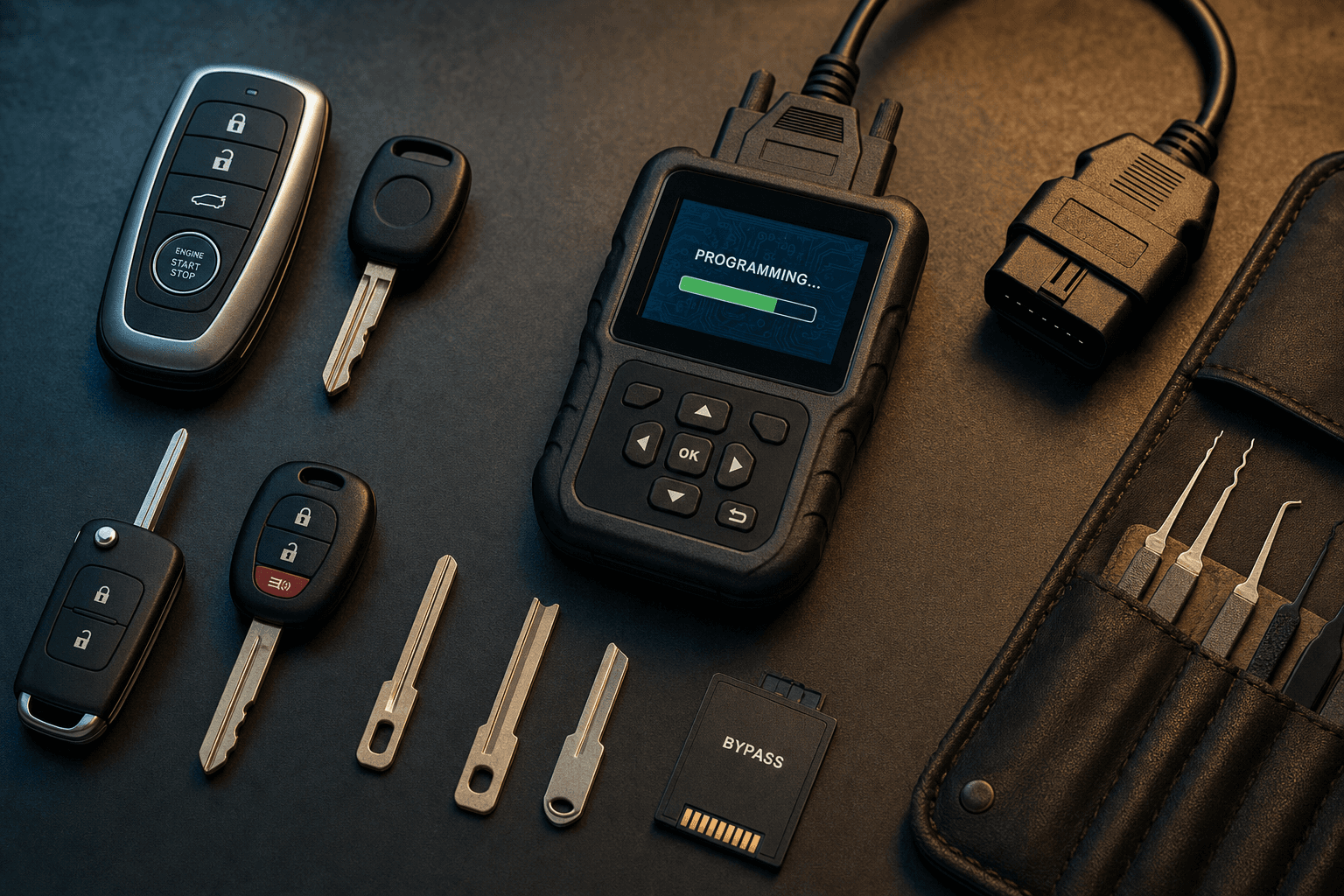
A transponder key carries a small chip in the plastic head that answers the car's immobilizer with a code every time you turn the ignition. If the chip is missing, blank or not registered to the car, the engine will crank and refuse to run even though the blade is cut perfectly. Transponder programming is the step of writing that chip into the vehicle so the car accepts it.
The technician comes to your address in Campbell, in Silicon Valley. The dispatch line at (888) 492-0666 is answered around the clock, and the dispatcher confirms the details and an ETA before anyone is sent.
What's included in Campbell
- Identification of the chip family your vehicle uses from the year, make and model, and sometimes by reading your existing key
- Blade cut to the vehicle's key code or to a clean, unworn original
- Chip initialization, then pairing to the immobilizer through the OBD port or the manufacturer's onboard procedure
- Cloning onto a cloneable chip when you have a working key and the vehicle's chip type supports it, which leaves the immobilizer untouched
- Start test from cold with each key, plus door and trunk operation on the new blade
- A note of how many keys the car now has registered, so you know where you stand
What to have ready
- Photo ID and registration or insurance card for the vehicle
- Year, make, model and trim
- Every working key you have; some pairing procedures need two existing keys, and cloning needs the original present
- The hardware-store copy if you had one cut; the blade may be usable even though it will not start the car
- Confirmation that the car starts normally with your current key and the battery is healthy
Time on site and limits
Typically 20-45 minutes to add a transponder key next to a working one. Cloning is at the fast end; pairing through the diagnostic port on makes that require a security PIN, an immobilizer wait or a two-key onboard procedure sits at the slower end, and an all-keys-lost job on the same vehicle is a separate, longer service.
- Several makes need a security PIN or immobilizer code to add a key; we obtain it through legitimate channels with proof of ownership, which can add time and is not available for every year
- Encrypted chip families (Toyota and Lexus 8A and DST-AES, Honda ID47 on later years, Ford ID49, Hyundai and Kia AES) usually cannot be cloned and have to be paired through the port
- Vehicles behind a dealer security gateway, including many 2018-and-newer Chrysler, Dodge, Jeep and Ram models, need gateway authorization before programming; we confirm on the phone
- Some onboard procedures require two working keys; with only one key the job becomes a tool-based add, and with no keys it becomes an all-keys-lost job
- A low 12V battery or a car that has been sitting can corrupt a programming session, so we check voltage first
- Aftermarket remote starters and immobilizer bypass modules sometimes hide a cloned chip in the dash; we point it out if we find one, since it affects your car's security
Pricing for transponder key programming
The quote reflects the chip type and blank, whether the key can be cloned or must be paired through the port, whether a security code has to be retrieved for your make, the number of keys you want, and the time of day. Adding a key while you still have one working key is the least expensive version of this service; an all-keys-lost origination is quoted separately.
The dispatcher gives you a range on the phone, and the technician confirms a written quote before any work starts.
Payment is by Cash, Credit Card, Debit Card, Apple Pay and Google Pay, and you receive an itemized receipt listing what was done.
Key types
- Texas Instruments 4C, 4D-60 through 4D-72, DST80 and DST-AES (Toyota, Lexus, Scion, Subaru, older Ford and Mazda)
- Philips/NXP ID46 and Hitag 2 (GM, Honda and Acura to about 2013, Nissan and Infiniti, Chrysler, Dodge and Jeep, Mitsubishi)
- Megamos 48 and Megamos AES (VW, Audi, Seat, Skoda)
- Honda and Acura ID47 (Hitag 3), Ford and Lincoln ID49 (Hitag Pro), Toyota H-key 8A
- Hyundai and Kia ID46, ID47 and later AES chips
- Cloneable blanks (CN, YS, LKP and similar families) for chip types that permit cloning
Local notes for Campbell
Campbell is a small Santa Clara County city between San Jose, Los Gatos and Saratoga. Downtown runs along East Campbell Avenue near the old railroad line, anchored by the 1928 water tower, the Heritage Theatre and the Ainsley House museum, with the open-air Pruneyard Shopping Center nearby; Winchester Boulevard and Bascom Avenue are the main north-south arterials and Hamilton Avenue crosses the north side. Most homes are single-family houses built in the 1950s through 1970s, typically 1,000 to 1,600 square feet on roughly 6,000-square-foot lots. CA-17, CA-85 and San Tomas Expressway serve the city, and VTA light rail has three stations on the Winchester line.
Getting to you: CA-17 and CA-85 serve the city, with San Tomas Expressway on the west side and I-280 just north; VTA's Winchester light rail line has three stations in Campbell, and downtown is a compact grid along East Campbell Avenue.
ZIP codes served: 95008, 95009. Addresses just over the line in San Jose, Los Gatos and Saratoga are dispatched the same way.
Reach the dispatcher at (888) 492-0666
For transponder key programming in Campbell, tell the dispatcher your address and what is wrong. You get an ETA before anyone is sent, a written quote before any work starts and a receipt when it is done. The line is answered around the clock.
One & Only Locksmith is bonded and insured; a certificate of insurance is available on request.